An Update in Autumn Colors
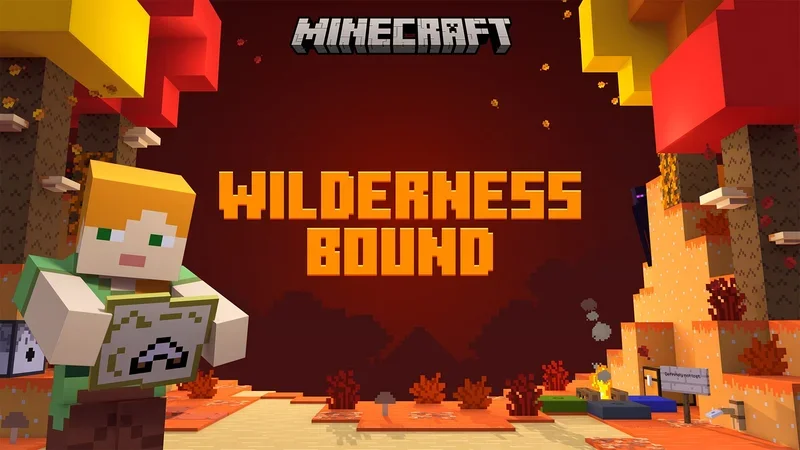
Minecraft Wilderness Bound was released on September 15, 2026. The third game drop of the year, it went by the working names Drop 3 of 2026 and then Fall Drop 2026 until its final title was revealed during MC Championship Fall Stars. The initial announcement dated back to Minecraft Live in May 2026.
| Edition | Version |
|---|---|
| Java Edition | 26.3 |
| Bedrock Edition | 26.50 |
Its features had been playable ahead of release, through the Bedrock Edition 26.40 experiments.
The theme leaves no room for doubt. A new autumn forest biome, a brand new wood type in three colors, decorative blocks players have been asking about for years, and a structure to explore.
The Dappled Forest, the Heart of the Update
The dappled forest is an autumn-themed forest biome that generates near cold biomes. It features poplar trees, patches of coarse dirt, red shrubs, leaf litter, brown mushrooms, shelf mushrooms and sparse spruce trees.
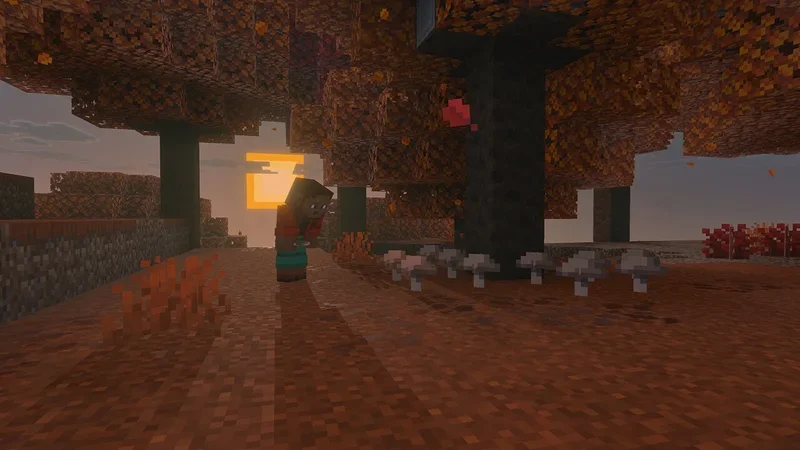
Two details are worth pointing out. Fallen poplars generate far more frequently here than fallen trees in other biomes, which makes for a very cluttered forest floor. As for wildlife, you will run into rabbits, foxes and the cold variants of farm animals.
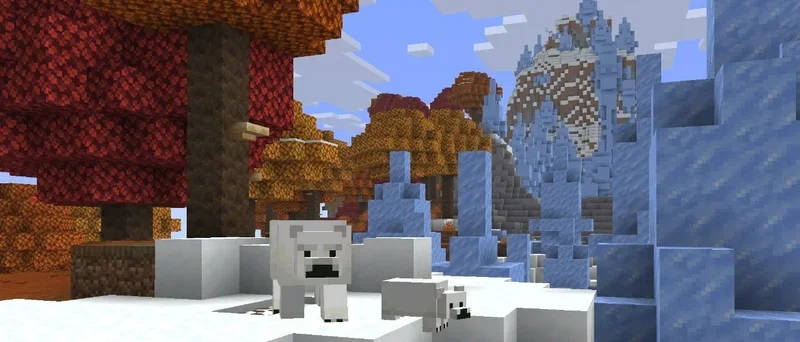
The red shrub is a bush variant specific to this biome. Amusing quirk, it stays red no matter which biome you replant it in.
Poplar, a Complete Wood Set
Poplar arrives with the full block set, nothing is missing. Log, stripped log, wood, stripped wood, planks, stairs, slab, sign, hanging sign, button, pressure plate, door, fence, fence gate, trapdoor and shelf, plus the boat and the boat with chest.
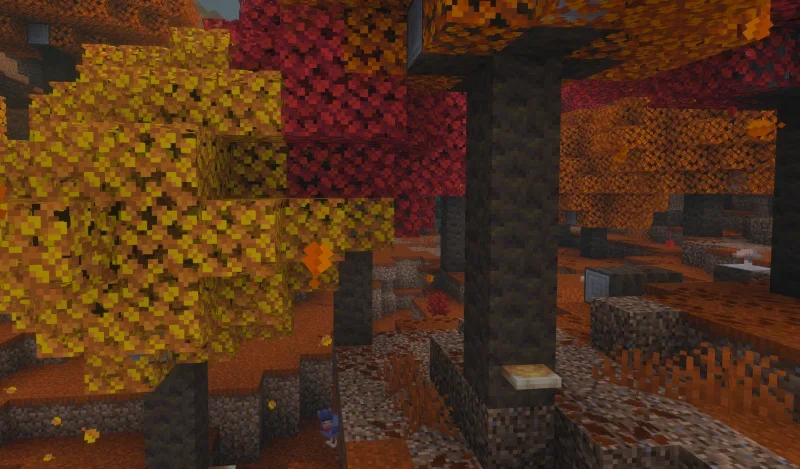
Its real signature is its leaves in three colors, red, orange and yellow. Each tree's shade is decided at random during world generation, which produces mottled forests rather than uniform ones. The leaves emit falling particles matching their color, as frequently as pale oak or cherry leaves. They also produce ambient sounds when attached to a log and surrounded by at least three identical leaf blocks on their four horizontal sides.
The shelf mushroom grows naturally on poplar trees, standing and fallen alike. It comes in two sizes, the small one can be grown with bone meal, and breaking a large one drops two mushrooms. It can only be placed on full block faces, it is bouncy when an entity lands on it, and it works as an ingredient in mushroom stew, suspicious stew and rabbit stew.
Abandoned Camps
This is the new surface structure, and it generates across a remarkably wide range of biomes.
| Family | Biomes |
|---|---|
| Forests | Forest, Birch Forest, Old Growth Birch Forest, Flower Forest, Windswept Forest, Dappled Forest |
| Taigas | Taiga, Snowy Taiga, Old Growth Spruce Taiga, Old Growth Pine Taiga |
| Jungles | Sparse Jungle, Bamboo Jungle |
| Others | Meadow, Cherry Grove, Swamp, Savanna, Wooded Badlands, Pale Garden |
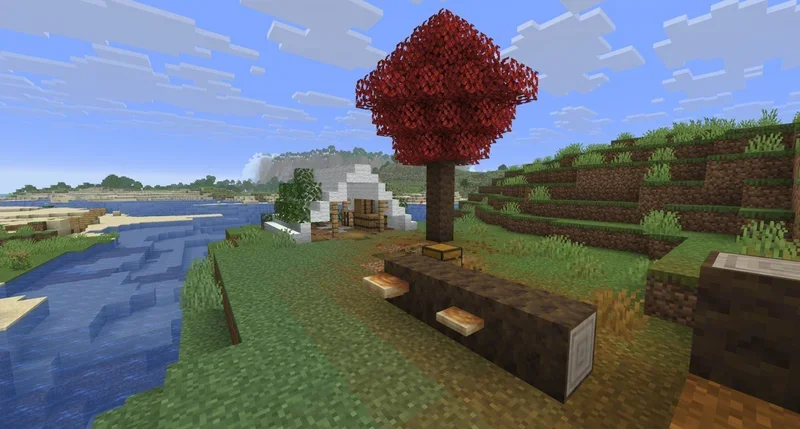
The tent is built mainly from white wool stairs, straw beds and fences whose wood type depends on the biome. The rest varies a lot between instances, featuring in some cases a stone shelter, a pond, a crop farm, a tree, or overgrown elements with leaves and cobwebs.
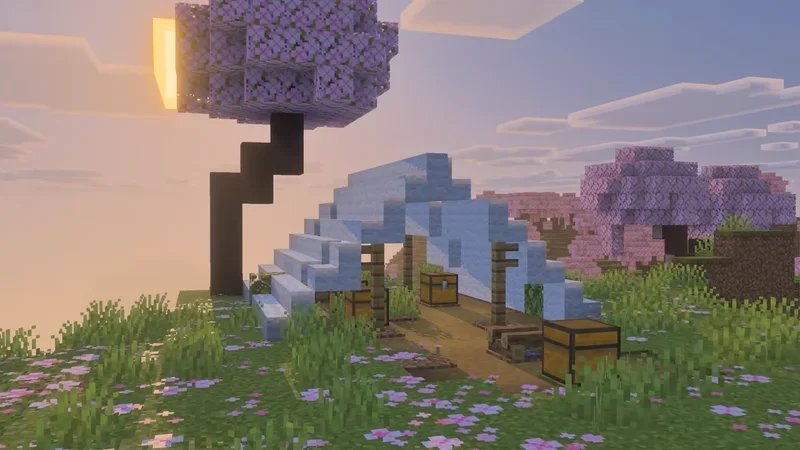
As for loot, expect chests, barrels, and above all a hidden oxidized copper chest that rewards players who search thoroughly. Once tidied up, a camp becomes a proper waypoint, with its straw beds under the tent and a campfire for the night.
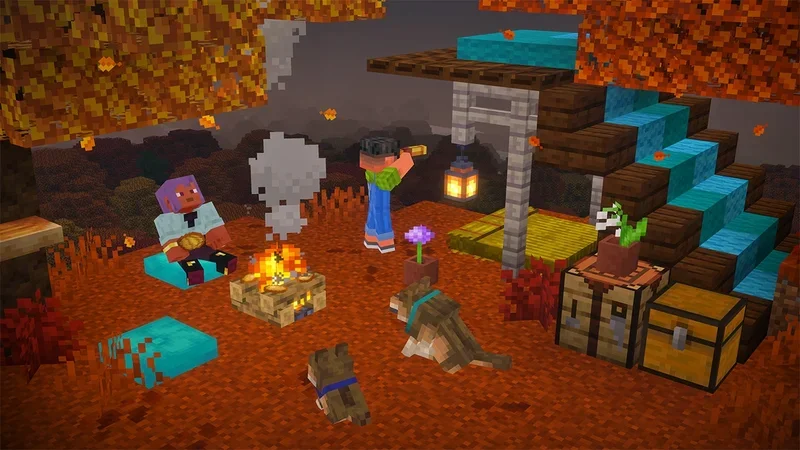
A bit of trivia, the feature did not always carry that name. The first Preview announced it as the wandering trader's hidden stashes, before the second one renamed it to abandoned camps. The trader did not vanish though, you will readily meet him around campsites.
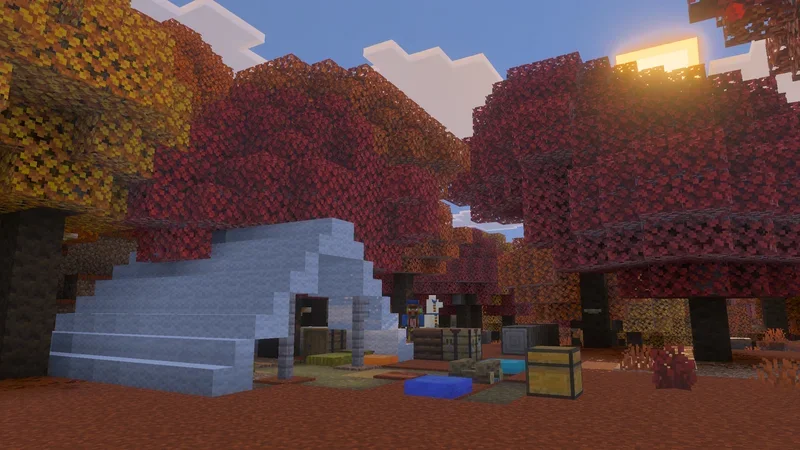
Wool and Concrete Stairs at Last
This is probably the addition builders were waiting for most. Concrete and wool now have their own stairs and slabs, in all sixteen colors. Both are crafted from the matching full block, and concrete can also be cut in a stonecutter.
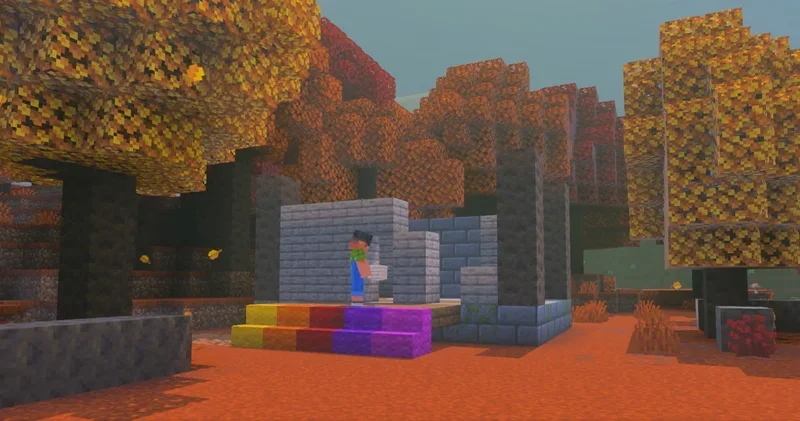
Combined with poplar wood, these new blocks open building palettes that full wool and concrete never allowed, sloped roofs, tiered seating, colored furniture.

Cushions and Straw Beds
The cushion is a decorative entity rather than a block. It can be sat on, placed on any surface regardless of height, and stacks to 16. It is crafted from 3 wool slabs of the matching color and comes in all sixteen shades. Be careful, it breaks when moved by pistons or when its supporting block is removed.
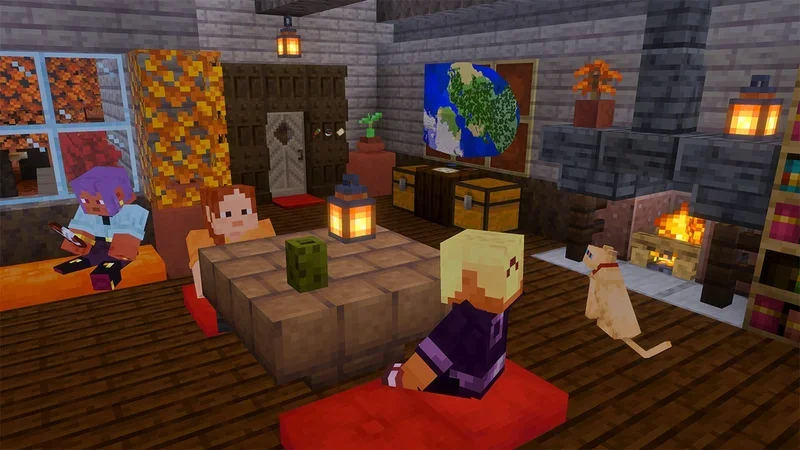
The straw bed answers a long-standing need, sleeping through the night without moving your spawn point. Four straw beds are crafted from 3 hay bales and stack to 16. The trade-off is that it is single use and is destroyed after use, even if you leave the bed before morning. In the Nether and the End it breaks, but without exploding unlike a regular bed. Villagers, for their part, do not use it.
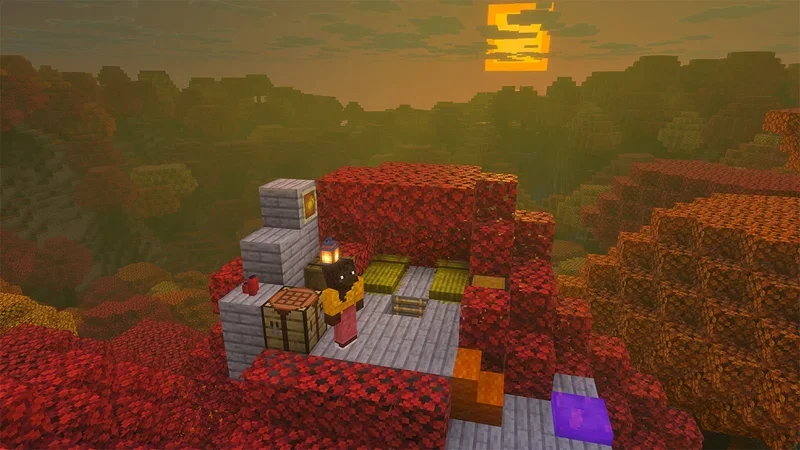
Both generate naturally in abandoned camps.
The Recipes Worth Knowing
A recap of the crafting introduced or changed by this update.
| Item | Crafting |
|---|---|
| Concrete stairs and slabs | From the concrete block, or in a stonecutter |
| Wool stairs and slabs | From the wool block |
| Cushion | 3 wool slabs of the matching color |
| Straw bed | 3 hay bales, for 4 beds |
| Poplar boat | Poplar planks, chest version included |
| Mushroom stew | Any two mushrooms and a bowl |
| Suspicious stew | Any two mushrooms, a bowl and a small flower |
The most useful day-to-day change concerns the stews. They previously required one red and one brown mushroom, whereas any two mushrooms now do the job. And since the shelf mushroom also counts as a mushroom, a dappled forest becomes a food source on its own.
Maps Get a Rework
The map system has been seriously revised. Explorer maps become unique items, with their own distinct textures, and some were renamed in the process. The player icon on locator and explorer maps now always shows the direction the player is facing.
Seven maps become distinct items, the buried treasure map, the jungle pyramid map, the ocean monument map, the swamp hut map, the buried trial chambers map, the woodland mansion map and the village map. The woodland mansion map icon was redrawn as well.
Abandoned camps bring two new families of maps. In their common chests, eight abandoned camp maps lead to the bamboo jungle, cherry grove, birch forest, dappled forest, flower forest, pale garden, swamp and windswept forest. In the secret chest, four structure maps point to a buried ancient city, a buried mineshaft, a desert pyramid and warm ocean ruins.
One thing to know, explorer maps can no longer be zoomed out at a cartography table.
Other Changes
- Mushroom stew and suspicious stew now accept any combination of two mushrooms, where they previously required one red and one brown mushroom specifically.
- The hay bale texture was tweaked, its strap moved down one pixel to better align with the straw bed.
- Spruce leaves no longer produce falling particles in Java Edition.
The Camp Out Community Challenge
From September 26 to October 2, Mojang ran a community challenge around the update. Players worldwide had to accumulate placed straw beds and crafted cushions to unlock reward tiers, a skin pack on Java Edition and Character Creator items on Bedrock. On the menu, the Pillow Suit, the Red Shrub Onesie, the Sleep Mask and the Deluxe Shelf Cap, the latter requiring 25 million straw beds and 100 million cushions across the community.
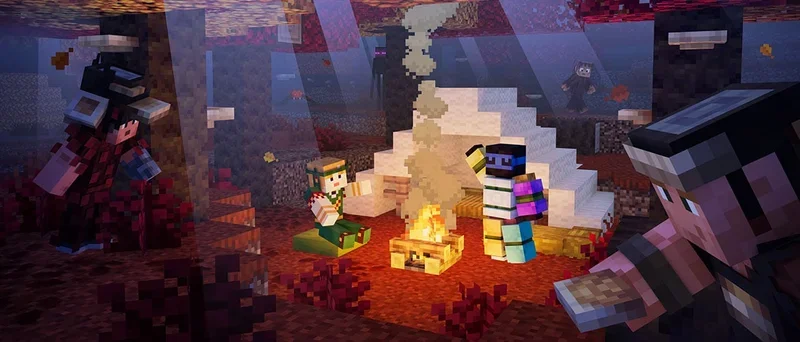
The challenge is over, but it gives a sense of how much weight Mojang puts on the update's two flagship items, the cushion and the straw bed.
The Versions That Followed
On Bedrock, 26.51 shipped the same day on Windows and PlayStation, and the next day on the other platforms, to fix a crash when opening a specific world. 26.52 followed on September 25 with a batch of fixes, including a launch crash on iOS, projectiles hitting players in Spectator mode, cushions disappearing when a world was reloaded, and better network stability on Nintendo Switch.
26.60 is announced for October 27, 2026. It will bring the first native version for Nintendo Switch 2, with Vibrant Visuals and a render distance raised to 28 chunks, and will open the experiments of the year's fourth drop, ice caves, a new zombie named Frostbite that throws ice balls, and a freezing effect with its potions and arrow.
On Java, no 26.3.x hotfix has been published to date.
Under the Hood, for Technical Users
A few useful markers if you manage packs, plugins or add-ons.
| Element | Value |
|---|---|
| Protocol version | 777 |
| Data version | 5023 |
| Resource pack format | 97.1 |
| Data pack format | 121.0 |
| Minimum Java version | Java SE 25 |
Java Edition gains two commands, /compute to evaluate number providers, and /posteffect to apply, list or remove client-side post-processing effects. Several previously hardcoded behaviors move to data components, the #brewing_fuel tag goes away in favor of the brewing_fuel component, and axes, hoes and shovels now rely on block_transformer. An invulnerable_time tag makes a mob temporarily invulnerable, and the gameplay/straw_bed_rule environment attribute governs straw bed behavior, on the same model as the regular bed rule.
On Bedrock, the dedicated server moves to 1.26.50.5 with protocol 2193. Worth noting for add-on creators, entity JSON schemas containing invalid data now refuse to load, where they previously passed silently.
What This Means for Your Server
The dappled forest will not appear in your already generated chunks. As with any new biome, you will need to explore untouched areas to find it, or start a fresh map. Let your community know, it saves you tickets.
Back up before updating. A version change remains the riskiest operation on a server, especially with plugins or add-ons installed.
On Java, check your environment. A 26.3 server requires Java 25 at minimum. Data packs must follow format 121.0 and resource packs format 97.1, a pack built for an earlier version may refuse to load or behave differently. Plugins, for their part, depend on the pace of their own project.
On Bedrock, not everything moves at the same pace. The official update is available immediately on Mojang's dedicated server, whereas third-party software such as PowerNukkitX has to adapt its code first. Watch for a compatible release before switching over. And if you use add-ons, make sure they are valid, 26.50 no longer loads malformed entity schemas.
Plan ahead for 26.60. On the Bedrock dedicated server, the warning urging a switch to NetherNet will become an error when NetherNet is not in use, as RakNet is deprecated. New server properties will also set persistent and transient ticking area limits.
Frequently Asked Questions
Does the dappled forest appear in an existing world?
Not in the areas you have already explored. A new biome only generates in chunks created after the update, so you need to head out into untouched land, or start a fresh map.
Which Java version does a 26.3 server need?
Java 25 at minimum. A server launched with an earlier version will not start.
Does the straw bed change my spawn point?
No, and that is exactly the point. It lets you sleep through the night without touching your spawn point, in exchange for being destroyed after use.
Can explorer maps still be zoomed out?
No. Explorer maps can no longer be zoomed out at a cartography table since this update.
Will my PowerNukkitX server move to 26.3 automatically?
No. Third-party server software adapts its code at its own pace. You need to wait for a compatible release, then run the update from your panel.
Fancy setting up a server to explore the dappled forest with friends? Our plans are available for Minecraft Java, Minecraft Bedrock and Minecraft Bedrock PowerNukkitX.
Sources, the Wilderness Bound, Java Edition 26.3 and Bedrock Edition 26.60 pages of the Minecraft Wiki, which mirror Mojang's official release notes. All images are published by Mojang.
Happy exploring under the poplars 🍂